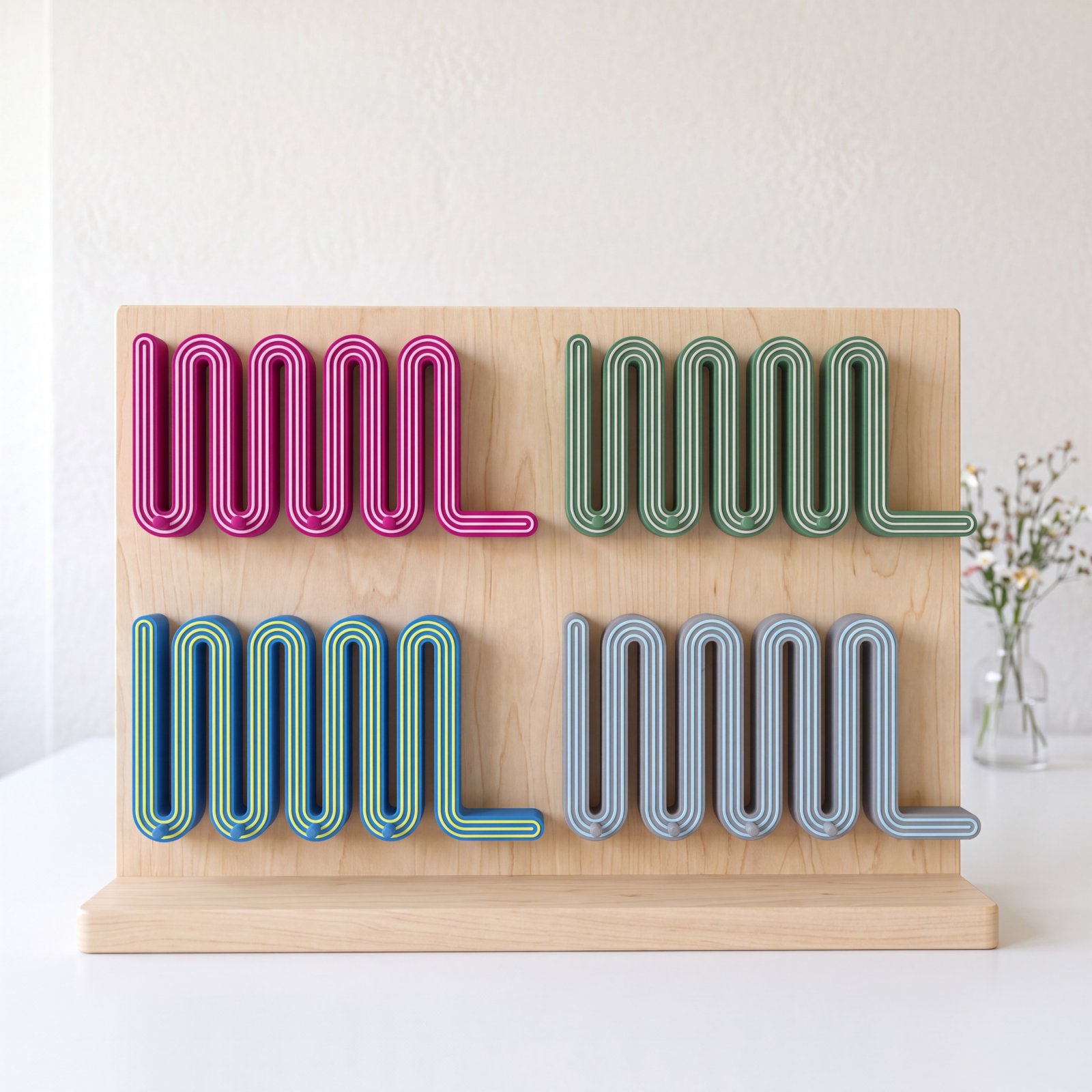
Every key holder that leaves the East Coast Art Supply workshop in Wilmington, North Carolina starts as a flat drawing. Not a 3D model, not a sculpt: a two-dimensional outline of a cloud, a run of paint drips, a set of waves, or a dog bone. That outline is an SVG file, and it stays the single source of truth from the first sketch to the finished, multi-color 3D printed key holder a customer hangs by the door.
This is a how-it's-made piece about that workflow, written for makers and small 3D-print shops turning a shape they like into a product line. The short version: if your product is a silhouette with hooks on it, vector artwork is the most direct path to a printable model, to clean multi-color prints, and to a customizer buyers can use before you press print.
The shop: made to order on the North Carolina coast
East Coast Art Supply makes modular wall organizers, key holders, and home décor in Wilmington, NC. Pieces are handcrafted to order and made with recycled materials, and many designs can be ordered in whatever colors the buyer picks. The catalog is organized into collections named after their shapes and styles: Wavy, Mountain, Boho, Drippy, Geometric, Desert Sunset, Pup, Mosaic, and Cloud. There is also a bulk option for realtors who want closing gifts, and free shipping on orders over $50.
All of those collections come out of the same process, which starts in a vector editor rather than a CAD package.
Why start with an SVG instead of a 3D model
A wall key holder is, structurally, a flat plate with hooks. The plate is where the personality lives: the roundness of the cloud, the way the drips hang, the rhythm of the waves. That is two-dimensional information, and modeling it directly in 3D means fighting a tool built for mechanical parts to get an organic curve right, then fighting it again every time you want to nudge that curve.
Vector artwork sidesteps that, which is why an SVG to 3D print workflow suits products like these. An SVG outline is resolution-independent, so one file scales to a small key holder or a larger organizer without redrawing. It is trivially editable: move one anchor point and the whole drip changes. And it carries color structure for free: every closed path is a candidate color region, which matters once you print in more than one color or let a buyer choose their own. If the shape is the brand, draw it in the tool that is best at shapes.
How it's made: from flat outline to a custom wall key holder
Here is the path a design takes at East Coast Art Supply, in general terms; the order of operations matters more than the specific tools.
- Draw the silhouette as a closed vector path. The cloud, the drips, the waves, and the bone are each drawn as 2D artwork: closed paths only, no stray points, no self-intersecting curves. Anything that would confuse an extrusion gets fixed here, while it is cheap.
- Split the artwork into color regions. Each area that will print in its own color becomes its own closed shape, and where two regions touch they share an edge exactly. This step decides what a customer can later recolor, so it is a product decision as much as a drawing decision.
- Extrude the regions into solid bodies. The flat shapes are given thickness, and the hook and organizer geometry is added to the plate along with whatever the piece needs to hang on a wall.
- Export the print files. The model goes out as 3D-print files with the color regions kept as separate bodies, so each can be assigned its own color.
- Print in multiple colors. Each region is printed in its chosen color, and because the regions were defined in the SVG, the boundaries land exactly where the artwork said they would.
- Finish and ship. There are real humans behind every piece, and the shop lists a make time of one to three days for custom orders.
- Reuse the same regions in the customizer. The model and its color regions are uploaded again to power the live preview on the shop's customize page; the regions a buyer clicks are the regions that get printed.
Why the same SVG regions power the live customizer
Step seven is the part most small shops skip, and it is what turns a nice product into a customizable one. The live color and name preview on East Coast Art Supply's customize page is Configura Studio's embedded 3D customizer. The seller uploads the print model, marks the color regions and the text area, and gets an embeddable viewer for their own site. The buyer picks a color for each region, types a name if the design has one, and watches the model update; the order arrives with the exact colors and name, ready to print. The seller side is covered in more detail in how Configura Studio works for sellers.
What a buyer actually does
From the customer's side it is a short sequence: open the page to design a custom wall key holder in your colors, pick a style, choose a color for each region, add a name where the design allows it, check the preview, and order. Four designs are customizable this way today: the Pup Custom Dog Leash Holder, the Drippy Key Holder, the Custom Wavy Wall Key Holder, and the Cloud Key Holder. All are made to order, and all let the buyer pick any colors.
Design notes from four silhouettes
Each customizable shape teaches something different about taking vector art to a printed object. These are observations about the geometry, not instructions from the shop.
Cloud: soft curves and generous features
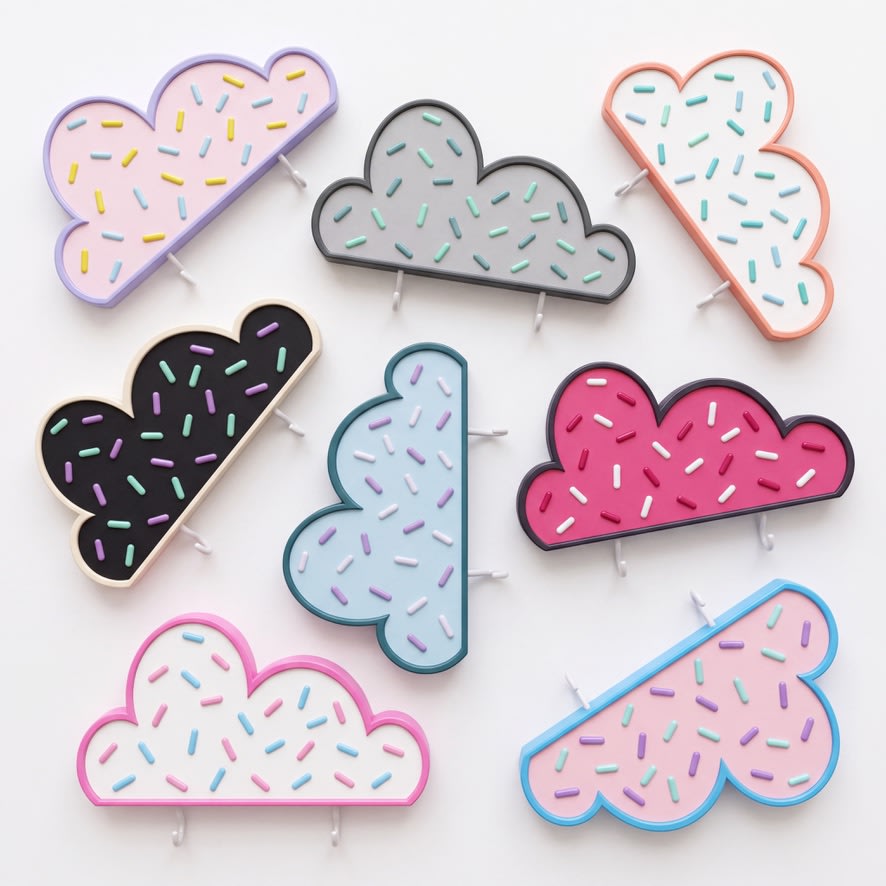
The cloud is the friendliest shape to extrude: a chain of convex bumps with no narrow necks, so nothing is fragile once it has thickness. The design work is mostly proportion, how puffy the top is and how flat the base is where the hooks go. The cloud key holder collection leans into pastel palettes. The regions are large and simple, so the colors read clearly.
Drippy: thin features are the stress test
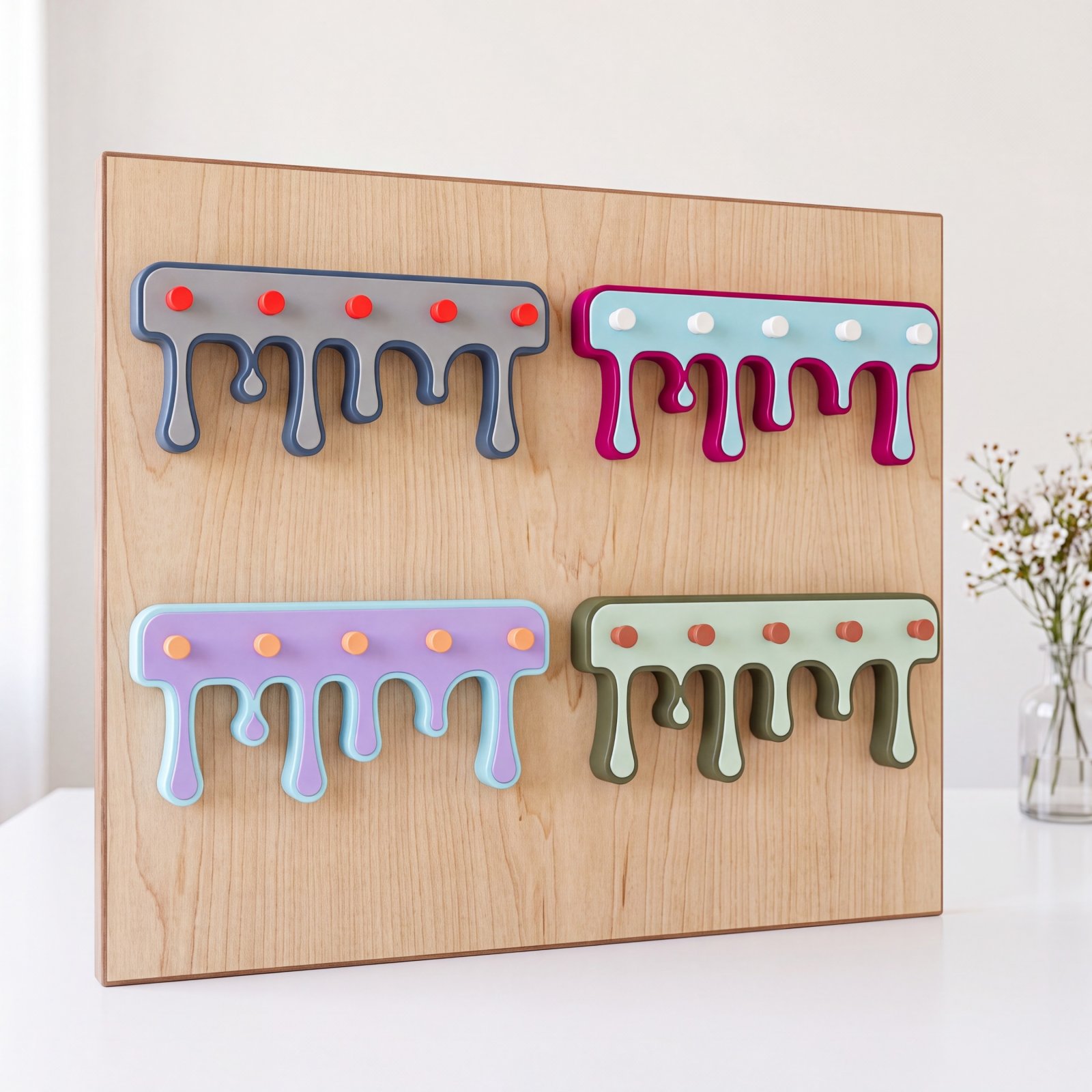
The Drippy design is a bold melted-paint silhouette, and the drips are the part to watch. In a vector editor a drip can be as thin as you like; in a printed part it needs enough width to survive extrusion, printing, and years of keys hung on it. The drips are also where color boundaries are most visible, so they have to line up exactly. Browse the drip key holders made to order in Wilmington and notice that every drip is wide enough to hold its shape.
Wavy: color blocks that meet along a curve
The Custom Wavy Wall Key Holder is built from bold curves, and its color regions meet along the wave lines rather than straight edges. That is easy to draw and satisfying to print, because the wave becomes the seam: a region boundary can be part of the design rather than something to hide.
Pup: a shape with a name on it
The Pup Custom Dog Leash Holder is bone-shaped and holds leashes and collars by the door. It is also the design with a text area: the buyer types their dog's name and sees it on the model before ordering, which means reserving a flat, legible stretch of the silhouette for text at the vector stage. The custom dog leash holder collection shows how much personality a single word adds to a simple shape.
What makers and small print shops can take from this
You do not need to sell key holders for this to apply; it works for any product whose identity is a silhouette: signage, wall hooks, ornaments, nameplates. A few habits are worth copying.
- Design for the wall, not the screen. A curve that looks delicate on screen has to hold a set of keys, so decide the minimum feature width before you draw.
- Decide color regions at the artwork stage. Splitting a vector into regions is far easier than cutting up a finished mesh. If buyers will choose colors, the regions are your product options.
- Keep one master SVG per design. Every colorway, size, and customizer variant should trace back to the same file, so a tweak to the outline propagates everywhere.
- Made to order means no color inventory. When every piece is printed after it is sold, you can offer any color combination without stocking any.
East Coast Art Supply is a small shop doing exactly this on the North Carolina coast. The lesson is not a particular tool: a thoughtful flat drawing, carried through extrusion, printing, and a live preview, can be the whole product pipeline.
Frequently asked questions
Can I choose my own colors for a custom wall key holder?
Yes. On the East Coast Art Supply customize page you pick a style, choose a color for each region, and see the result on a live 3D preview before you order. The piece is then made to order in those colors.
How long does a key holder made to order take?
The shop lists a make time of one to three days for custom pieces, plus shipping, and orders over $50 ship free. Each piece is printed after it is ordered, so there is no waiting on a color to come back in stock.
Can I put my dog's name on a leash holder?
Yes. The Pup Custom Dog Leash Holder is a bone-shaped wall organizer for leashes and collars with a text area for a name. You type the name on the customize page, see it on the 3D model, and the piece is made to order with that name in your colors.